

Fribourg Lab Research
Systems-level analysis of immune cell regulation and dysfunction



Research Directions
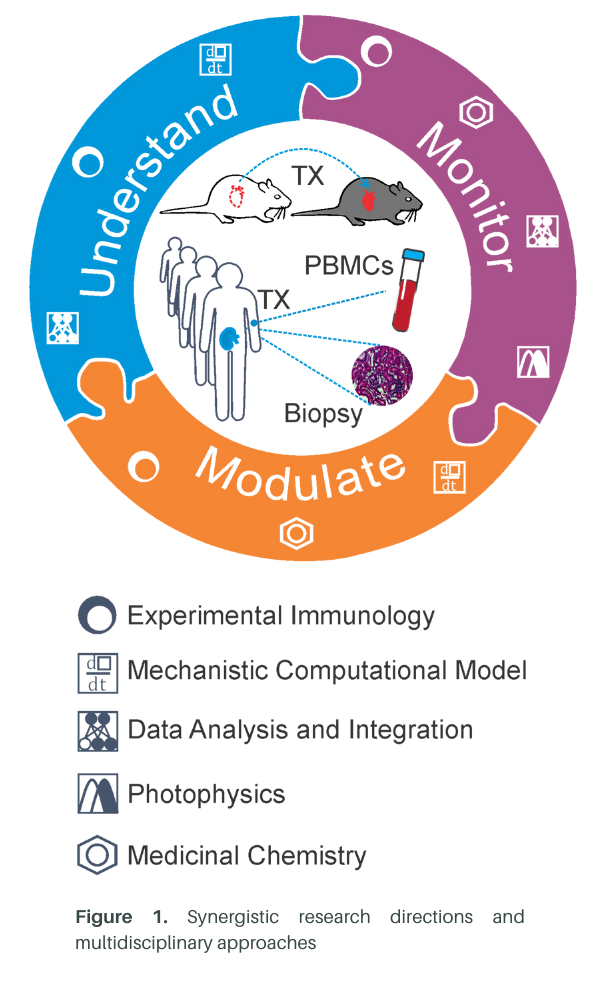
The Fribourg Lab research program is organized around three complementary research directions that integrate computation, experimentation, and translational insight. Together, these directions aim to uncover the mechanisms governing immune cell regulation, develop strategies to monitor immune function, and identify novel approaches to therapeutically modulate immune responses.
A. Mechanisms governing immune cell state balance
Concept
Immune cell fate and function emerge from the integration of multiple signaling, metabolic, and environmental cues. A central focus of our work is understanding how these inputs are processed differently by regulatory and effector T cells to establish immune balance or drive pathology.
Approach
We combine mechanistic computational modeling with experimental studies in murine and human systems to analyze signal integration and fate decisions in T cells. This includes quantitative modeling of signaling networks alongside in vitro and in vivo functional assays.
Representative insights
Using this integrated framework, we uncovered a previously unrecognized immunoregulatory mechanism of interferon-β, demonstrating its direct action on T cells to promote regulatory T cell stability through Foxp3 acetylation. These findings revealed unexpected links between innate and adaptive immunity and identified new therapeutic opportunities in immune-mediated disease.
B. Monitoring immune cell function in clinical contexts
Concept
Immune cell populations exhibit substantial functional heterogeneity that is not fully captured by static phenotypic markers. A major challenge in translational immunology is linking this heterogeneity to immune function in ways that are quantitative, interpretable, and compatible with clinical workflows.
Approach
We integrate high-dimensional single-cell data, including transcriptomic, phenotypic, and receptor-repertoire information, with computational data-integration frameworks to identify immune states associated with functional outcomes. In parallel, we develop chemical and photophysical tools, including fluorescent biosensors, to directly measure immune cell function at the single-cell level.
Representative insights
Using these approaches, we identified transcriptomic and phenotypic immune signatures associated with favorable outcomes in transplant recipients and developed functional assays to quantify regulatory T cell activity and redox homeostasis in clinical samples. Together, these efforts establish quantitative strategies to monitor immune function and inform patient stratification in immune-mediated disease.
C. Modulating immune cell function through pharmacological strategies
Concept
Immune cell fate and function are tightly regulated by post-translational modifications that integrate environmental and signaling cues. Selectively modulating these regulatory layers represents an opportunity to therapeutically reshape immune responses with greater precision than global immunosuppression.
Approach
We combine chemical design and synthesis with computational and mechanistic modeling to develop pharmacological strategies that target key regulatory nodes in immune cells. Candidate molecules are evaluated using quantitative in vitro assays and in vivo models to assess their effects on immune cell polarization and function.
Representative insights
Through this integrated approach, we discovered unexpected mechanisms by which small-molecule modulators of acetyltransferase activity enhance regulatory T cell function by reshaping protein acetylation networks. These findings provide a foundation for developing targeted immunomodulatory therapies that promote immune regulation while preserving protective immune responses.


Fribourg Lab PUBLICATIONS
